Guide 06 · Honey quality
How to produce high-quality honey
What separates honey buyers trust from honey they won’t buy twice.
Honey by flower: types found around Chipinge
Honey isn’t one product — its colour, flavour and market value all follow the flowers a colony forages. A hive sited in msasa woodland produces a different honey from one sited beside a citrus orchard, even a few kilometres apart. Knowing which of these your apiary is likely producing is the first step toward the provenance-based selling strategy covered on the Sell Your Honey page.
Msasa / miombo woodland honey
Source: Brachystegia and Julbernardia (msasa/mnondo) trees, the dominant woodland across Chipinge
Dark amber, robust and full-flavoured. The most widely produced single-origin honey in the district, and the closest thing Chipinge has to a signature honey.
Citrus blossom honey
Source: Citrus orchards around Chipinge and the Middle Sabi/Save valley estates
Light in colour with a delicate, faintly citrus aroma. A recognised premium single-origin honey internationally, which makes it one of the district’s strongest export-quality opportunities.
Eucalyptus honey
Source: Gum plantations grown for timber and firewood across the highlands
Amber with a slightly herbal, menthol-like note. Well known and generally well regarded in international honey markets.
Wildflower / multifloral honey
Source: Whatever is flowering nearest the apiary — the default for most hives that aren’t sited near a single dominant crop
Colour and flavour vary batch to batch. Perfectly good honey, but it can’t carry a single-origin claim — it’s sold as a general table honey rather than a premium provenance batch.
None of this is guesswork at harvest time — a rough sense of what was flowering near the apiary in the weeks before a harvest, noted alongside the date and location you’re already logging, is normally enough to make a credible provenance claim.
How honey is graded internationally
Buyers who take honey seriously — export buyers especially — check it against a small set of measurable standards, mainly drawn from the Codex Alimentarius honey standard used as the international reference point. None of these require expensive lab equipment to understand, and the first one you can test in the field with a simple refractometer.
| Metric | International limit | Why it matters |
|---|---|---|
| Moisture | ≤ 20% (heather honey ≤ 23%) | The single biggest driver of shelf life — honey above this ferments in storage. |
| HMF (hydroxymethylfurfural) | ≤ 40 mg/kg — Codex allows ≤ 80 mg/kg for honey produced in tropical climates, Zimbabwe included | Builds up with heat and age; signals overheating or long, poor storage. The tropical allowance matters — it means Chipinge honey isn’t unfairly penalised for the climate it’s produced in, provided it’s still handled and stored well. |
| Diastase activity | ≥ 8 Schade units (≥ 3 for naturally low-enzyme honeys, if HMF stays ≤ 15 mg/kg) | An enzyme naturally present in fresh honey; it degrades with heat, so a healthy reading is evidence the honey wasn’t overheated during processing. |
| Sucrose | ≤ 5 g/100g — citrus, acacia and eucalyptus honeys are allowed up to 10 g/100g | A basic authenticity check. Note citrus and eucalyptus get a wider allowance under Codex — worth knowing when grading those specific batches. |
Figures per the Codex Alimentarius Standard for Honey (CXS 12-1981). These same metrics are what the cooperative’s grading tiers on the Sell Your Honey page are built around.
It starts before you harvest
The biggest quality decision a beekeeper makes happens at harvest time, not afterward: honey taken before it’s fully capped and ripened carries too much water to store well, and no amount of careful bottling fixes that later. Ripe honey holds around 17–20% moisture; well above that and it ferments in the jar within weeks, developing a sour taste and fizzing that customers notice immediately and remember. If you have access to a refractometer through the cooperative, use it — otherwise, the capping and shake tests covered on the harvesting page remain the best field check available.
Straining, not stripping
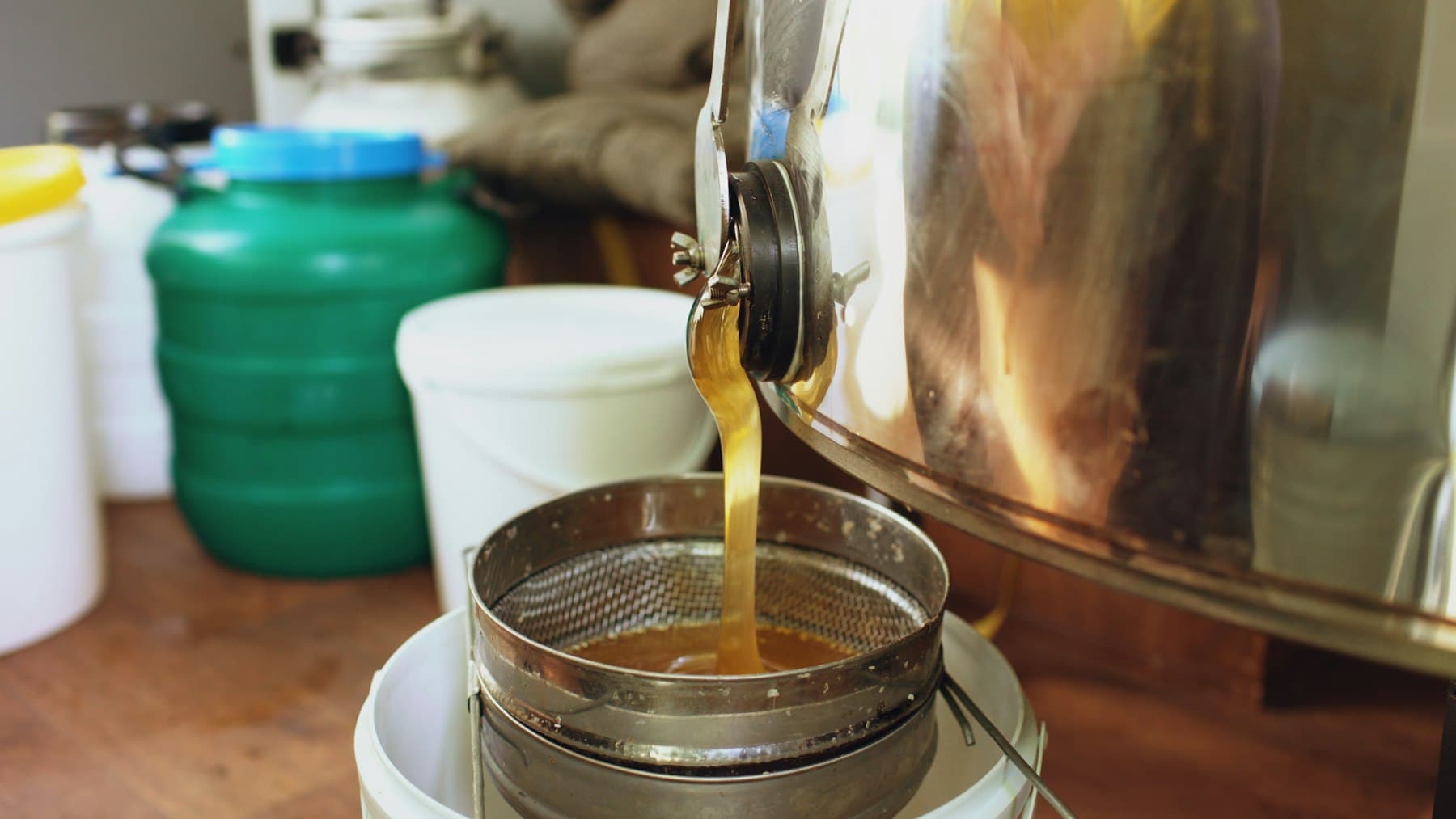
Once harvested, strain honey through a clean cloth or fine sieve to remove wax fragments, bee parts and debris — this is different from over-filtering, which strips out the pollen grains that give honey its character and its traceability to a particular region and season. A simple two-stage strain (coarse cloth, then a finer sieve) removes what needs removing without processing honey into something generic.
Clean handling, every step
- Use food-grade containers only — metal drums that have held anything else, or containers that have carried chemicals, taint honey permanently.
- Work in a covered, dust-free space; honey left open in the field picks up debris and attracts robbing bees and ants within minutes.
- Bottle into clean, dry glass or food-grade plastic jars — any residual water in a jar can locally raise moisture at the surface and start fermentation even in otherwise-ripe honey.
- Label with the harvest date and apiary — useful for your own records, and increasingly something buyers ask for directly.
Storage after bottling
Store bottled honey somewhere cool, dark and dry. Heat is the main enemy after bottling: honey held at high temperatures for long periods darkens, loses aroma, and builds up hydroxymethylfurfural (HMF), a compound that international quality standards specifically limit because it signals overheating or long, poor storage. A dark storeroom or a shaded shelf away from a tin roof in direct sun is normally enough protection in Chipinge’s climate. Crystallisation over time is natural and not a defect — a gentle warm-water bath, never direct heat or a stove, restores crystallised honey to liquid without damaging it.
Why this matters for the price you get
Adulteration — cutting honey with cheap sugar syrup — is a well-documented problem in honey markets generally, and it’s a large part of why buyers grew cautious about unfamiliar sources in the first place. Consistently ripe, cleanly handled, honestly labelled honey from the same cooperative and the same apiaries, harvest after harvest, is exactly what rebuilds that trust — and it’s the direct reason keeping good records of every harvest and sale, which this platform is built to make easy, is as much a quality practice as straining and bottling are. It’s also exactly what the cooperative’s aggregated selling strategy is built on: grade, provenance and clean records, batch after batch.