Guide 02 · Equipment
Required equipment & hive types
What Zimbabwean beekeepers actually use, and how to install it.
Three hive types, side by side
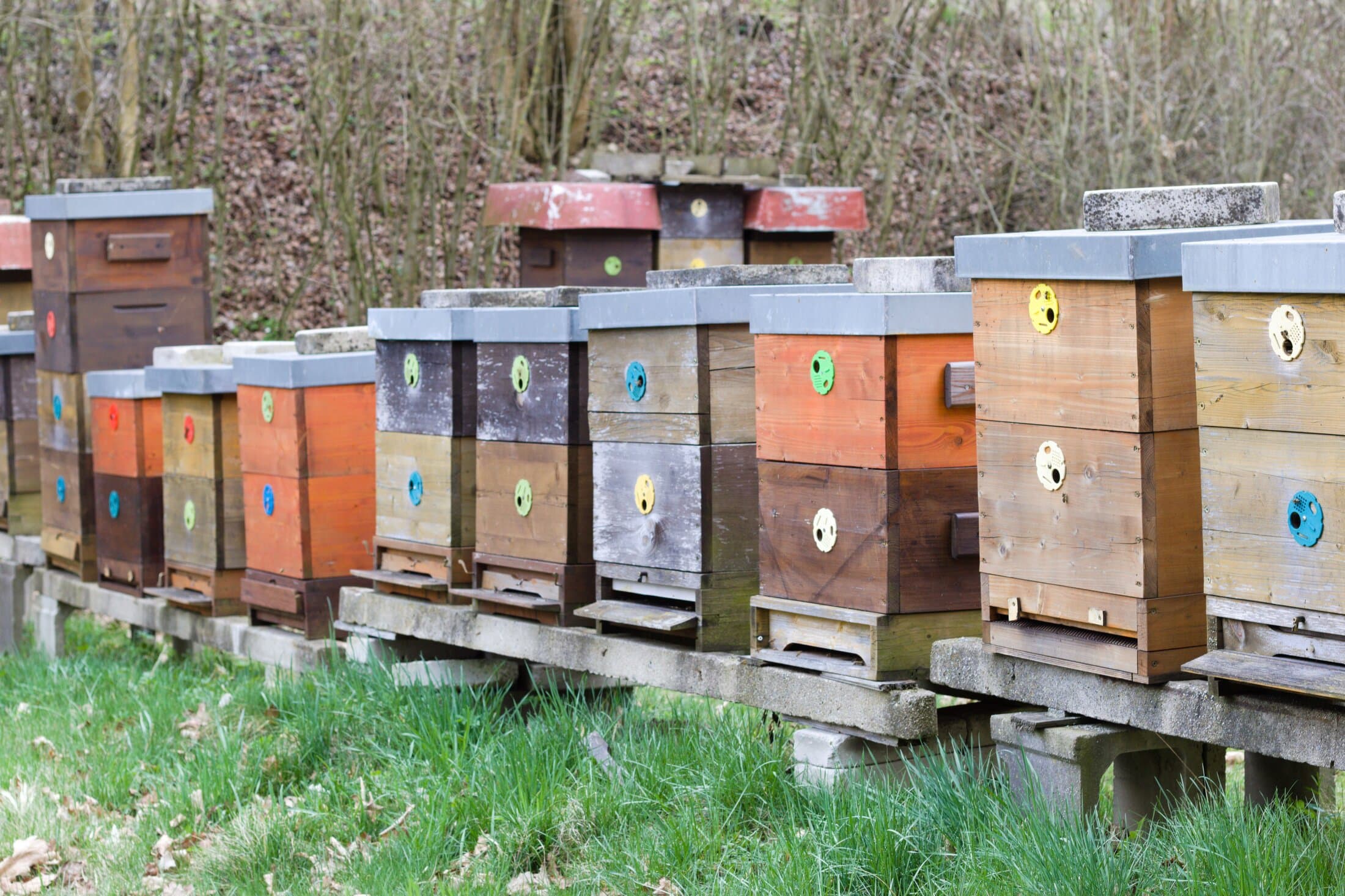
Zimbabwe’s apiaries run on three hive designs. Traditional bark and log hives still account for the large majority of hives nationally simply because they cost nothing to build; Kenya Top Bar Hives (KTBH) are the most common “improved” hive, promoted for years by NGOs and extension officers around Midlands and Mashonaland West; and Langstroth hives — the standard framed, stackable hive used in commercial beekeeping worldwide — remain the least common, mainly on cost grounds. None of the three is wrong. The right choice depends on how much cash you can put in up front, and how much control you want over inspecting and managing the colony.
| Hive type | Typical cost | Typical yield | Inspection |
|---|---|---|---|
| Traditional log / bark hive | Effectively free — built from local bark, a hollow log, clay pot or an old drum | ≈ 8 kg of honey per hive per year on average | Very limited — comb is fixed to the container and can’t be lifted out without destroying it |
| Kenya Top Bar Hive (KTBH) | Low to moderate — around $20–40 in materials if built locally from sawn timber | ≈ 16 kg of honey per hive per year on average — roughly double a traditional hive | Good — each bar lifts out individually so comb, brood and queen can be checked without destroying the nest |
| Langstroth hive | Highest — roughly $150–200 per hive for imported or well-built local equipment, plus an extractor if shared honey isn’t hand-pressed | Generally the highest of the three where colonies are strong and well managed | Excellent — removable framed comb, standard box sizes, and comb that survives extraction and can be reused |
Yield figures are averages from a comparative profitability study of improved vs. traditional hives in Zimbabwe — individual results vary with forage, weather and hive management.
Traditional log / bark hive
Advantages
- No cash outlay; uses skills and materials most rural households already have
- Familiar, low-tech, easy to build in an afternoon
Trade-offs
- Fixed comb means no real inspection for disease, pests or a failing queen
- Often built by stripping bark or hollowing a live tree, so scaling up costs forest cover
- Lower and less consistent colonisation and honey yields
- Harvesting usually destroys part of the comb, disturbing the colony more than necessary
Kenya Top Bar Hive (KTBH)
Advantages
- Movable comb enables real inspection and early problem-spotting
- Around double the yield and colonisation rate of traditional hives
- Cheap enough to build several from one load of timber
- Does not require imported frames, foundation or an extractor
Trade-offs
- Bars must stay in strict order — mixing them up can collapse fragile comb
- Comb is more fragile than framed comb and can break in hot weather or rough handling
- No standardised frames, so equipment isn’t easily shared between beekeepers using KTBH and Langstroth
Langstroth hive
Advantages
- Framed comb can be spun in an extractor and reused, saving the colony the energy of rebuilding it
- Standardised parts are easy to expand, repair or share with other Langstroth beekeepers
- Best suited to beekeepers planning to scale toward a larger, semi-commercial operation
Trade-offs
- Highest upfront cost, and the main reason it remains the least common hive type in Zimbabwe
- Heavier, bulkier equipment — harder to transport into remote apiary sites
- Needs more woodworking precision to build well; a poorly made box can gap and let in pests
How and where to install a hive
The siting rules below apply to all three hive types, whether you’re hanging a traditional log hive from a tree or bolting a Langstroth stand into the ground.
- Face the entrance east or south-east. Morning sun warms the hive early and gets bees foraging sooner, while afternoon shade — from a tree canopy rather than open sun — keeps the colony from overheating during Chipinge’s hottest months.
- Keep water within about 100–150 metres. A river, stream or even a shallow dish topped up regularly is enough — bees use water to cool the hive and dilute stored honey for feeding.
- Raise it off the ground. A stand, stump or suspended platform 30–45 cm up keeps out ants, termites and small predators, and stops rainy-season water pooling under the hive.
- Put real distance and a barrier between the apiary and people or livestock. At least 10 metres from footpaths and homestead buildings is a sensible minimum, more if children or animals pass nearby regularly; a hedge, fence or thicket between the hive and any path forces bees to gain height before they reach head level, which noticeably reduces defensive encounters.
- Break the wind. A site tucked among trees or along the leeward side of a slope keeps hives stable and reduces the energy bees spend fighting wind on every flight.
- Space hives 3–5 metres apart where you’re running more than one, so you can work around each hive without disturbing its neighbour, and so drifting bees don’t overload one entrance.
- Choose forest edges and riverlines where you can. This is exactly where Chipinge’s traditional beekeepers have always sited hives — close enough to forage on miombo woodland and riverine vegetation, far enough from the homestead to keep both people and bees calm.